Best Absolute Competitors and Alternatives for 2026

Absolute is a well-known name in cyber resilience, endpoint resilience, application resilience, endpoint recovery, patching, and downtime reduction.
.svg)


In this article, you’ll learn how Guardare compares to Armis and other exposure management alternatives, and why many organizations are looking for more unified ways to understand cyber risk.
You’ll learn:
Armis is a well-known name in asset intelligence, unmanaged device visibility, IoT, OT, medical device visibility, and cyber exposure management. Many organizations use Armis Centrix and related asset intelligence and exposure management capabilities to support security, IT, risk, or exposure management programs.
But as security environments get more fragmented, many teams are looking beyond traditional scanning, logging, asset inventory, managed services, or alert-based workflows.
The question is no longer just:
“What vulnerabilities do we have?”
It is:
That is where Guardare fits.
Guardare is an AI-powered Unified Exposure Management platform built to help organizations understand risk across users, devices, applications, identity, software, misconfigurations, and existing security tools.
Armis can be a strong platform for asset intelligence, unmanaged device visibility, IoT, OT, medical device visibility, and cyber exposure management, but companies often evaluate alternatives when they need broader exposure context, better prioritization, or a more unified view of risk.
A vulnerability becomes more or less important depending on the device it sits on, the user tied to that device, the user’s access level, the applications involved, whether the asset is internet-facing, whether controls are properly configured, whether other tools are already detecting related risk, and whether the issue connects to a larger attack path.
Guardare helps bring those signals together so teams can understand exposure in context.
Most organizations already have endpoint tools, identity tools, firewalls, vulnerability scanners, cloud platforms, SaaS applications, training platforms, SIEMs, ticketing systems, and reporting dashboards. The problem is not always a lack of tools. The problem is that the tools do not tell one story.
Guardare helps bring those signals together so teams can understand exposure in context.
A long list of vulnerabilities, alerts, assets, or workflow tickets does not answer the most important question: what should we fix first? Severity scores and alert counts help, but they are not enough on their own.
Guardare helps bring those signals together so teams can understand exposure in context.
Attack surface visibility is valuable because it shows what attackers may see from the outside. But external visibility is only part of the picture. Security teams also need to know who owns the asset, what device or application it connects to, whether it is managed, whether the related user has risky access, whether controls are missing or misconfigured, and whether the exposure connects to other weaknesses.
Guardare helps bring those signals together so teams can understand exposure in context.
Security leaders do not need another dashboard filled with findings. They need to communicate risk in a way the business can understand. Guardare helps turn fragmented technical issues into clear, prioritized exposure insights that can be shared with executives, IT leaders, and business stakeholders.
Guardare helps bring those signals together so teams can understand exposure in context.
Best for: Organizations that want unified exposure management across users, devices, applications, identity, software, misconfigurations, and security tools.
Guardare helps security and IT teams see how risk connects across the environment. Instead of looking at vulnerability data, user risk, device posture, SaaS exposure, identity context, and security controls separately, Guardare brings those signals together into a unified exposure view.
Key Guardare Capabilities
Why Choose Guardare Over Armis?
Armis is known for its core strengths in the security market. Guardare is built around a broader question:
What is actually exposing the organization?
That includes vulnerabilities, but also users, devices, applications, access, misconfigurations, weak controls, unused security features, and disconnected tool data.
Watch-Outs
Guardare is not positioned as a traditional SIEM, EDR, patch management, or managed security services replacement. It is best suited for organizations that want exposure visibility, prioritization, and decision support across the tools they already use.
Best for: Teams that need a more complete asset inventory across devices, identities, applications, users, and vulnerabilities.
Sevco Security is often considered by teams comparing Armis alternatives because it addresses a nearby security problem or serves a similar buyer need.
Strengths
Watch-Outs
Sevco can be strong where asset inventory is the primary problem, but buyers should evaluate whether they also need broader misconfiguration, tool utilization, user risk, and remediation guidance.
Best for: Organizations that need real-time endpoint intelligence, endpoint control, IT operations, and compliance.
Tanium is often considered by teams comparing Armis alternatives because it addresses a nearby security problem or serves a similar buyer need.
Strengths
Watch-Outs
Tanium is endpoint-first. Buyers should evaluate whether they need broader exposure context across users, SaaS applications, identity systems, security controls, and non-endpoint data.
Best for: Organizations focused on network modeling, cyber terrain visibility, and hybrid network risk analysis.
RedSeal is often considered by teams comparing Armis alternatives because it addresses a nearby security problem or serves a similar buyer need.
Strengths
Watch-Outs
RedSeal is network-terrain focused. Buyers should evaluate whether they also need exposure context across users, SaaS applications, identity, endpoint posture, software risk, and underused controls.
Best for: Organizations that want established vulnerability management, asset visibility, and exposure management capabilities.
Tenable is often considered by teams comparing Armis alternatives because it addresses a nearby security problem or serves a similar buyer need.
Strengths
Watch-Outs
Tenable can be a strong vulnerability management platform, but teams should evaluate whether it gives them enough context across users, devices, applications, identity, SaaS, and security controls.
Best for: Large enterprises that need vulnerability management, compliance, patching, and asset visibility in one mature platform.
Qualys is often considered by teams comparing Armis alternatives because it addresses a nearby security problem or serves a similar buyer need.
Strengths
Watch-Outs
Qualys can be powerful, but some teams may find the platform complex. Buyers should evaluate usability, reporting, remediation workflow, and whether the platform helps prioritize based on business context.
Best for: Microsoft-first organizations using Defender, Entra, Intune, Sentinel, and E5 licensing.
Microsoft is often considered by teams comparing Armis alternatives because it addresses a nearby security problem or serves a similar buyer need.
Strengths
Watch-Outs
Microsoft can work well for Microsoft-centric organizations, but companies with diverse SaaS, cloud, endpoint, and third-party security tools should evaluate how well Microsoft sees beyond its own ecosystem.
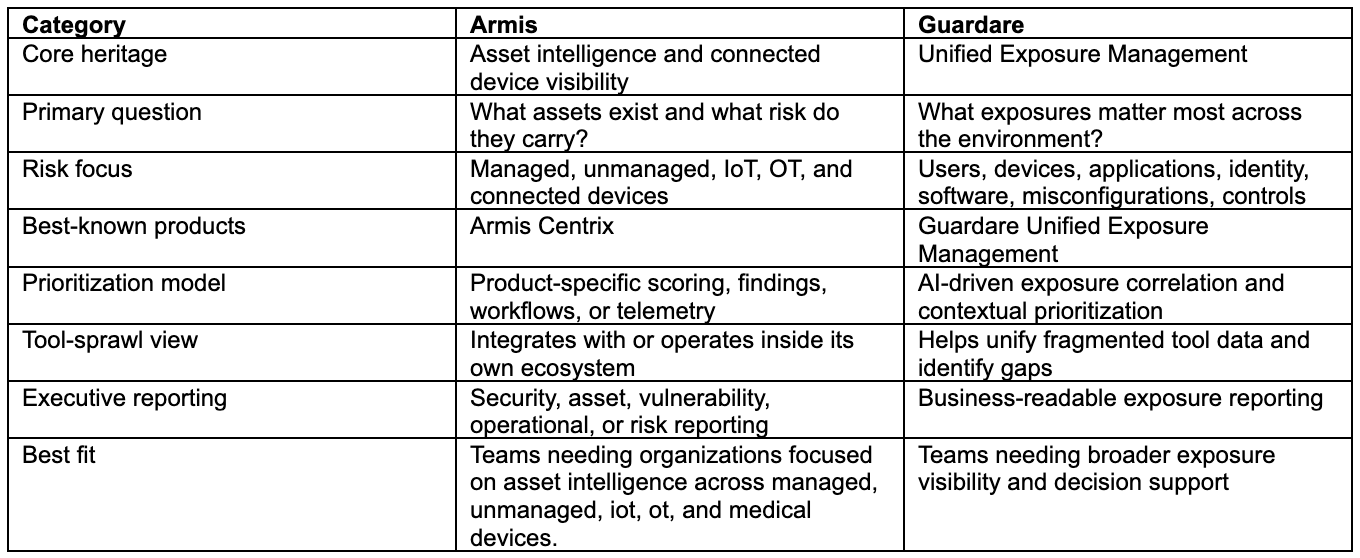
Exposure management is the practice of identifying, understanding, and prioritizing the weaknesses that create real risk.
That includes vulnerabilities, but it also includes much more:
Guardare helps teams move from isolated security findings to unified exposure management.
Instead of asking teams to manually connect asset scans, user data, device risk, SaaS findings, identity posture, and security tool outputs, Guardare brings those pieces into one risk model.
Guardare is especially useful for teams that want to understand:
Attack surface management helps identify what attackers can see from the outside. Many companies compare Armis with platforms that offer broader external discovery, internal context, or exposure correlation.
Guardare sees ASM as one piece of the larger exposure management problem.
Finding an exposed asset is valuable. But the next questions matter just as much:
Guardare helps connect ASM-style findings with internal risk context so teams can understand what the exposure means, not just that it exists.
Some buyers compare Armis with SIEM, XDR, MDR, vulnerability management, or security operations platforms. Guardare should not be positioned as a direct replacement for every one of those categories.
Instead, Guardare helps answer a different question.
A SIEM is generally focused on collecting and analyzing events. XDR is generally focused on detection and response. MDR is generally focused on managed monitoring and analyst support. Guardare is focused on understanding exposure before it turns into an incident.
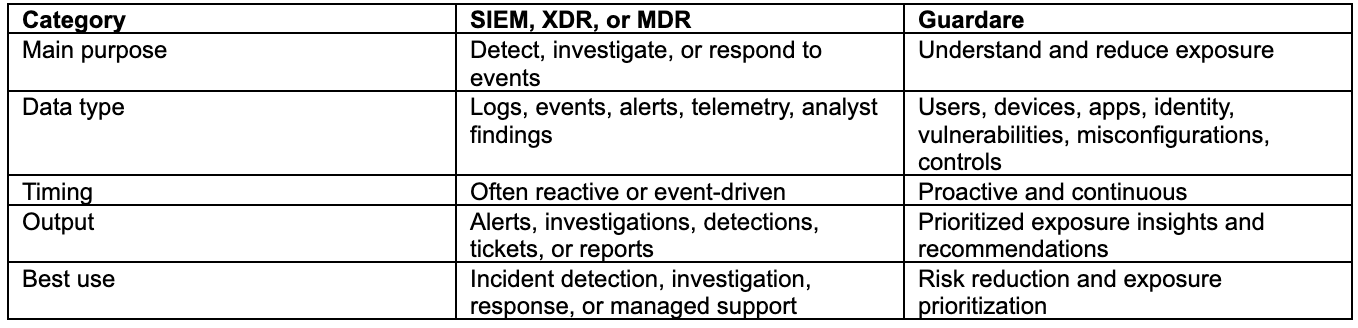
The two can work together. Detection and response tools can help show what is happening. Guardare can help reduce the conditions that make incidents more likely.
Armis may be a strong fit when:
Guardare is a better fit when:
When comparing Armis competitors, ask:
